One Size Fits None: How Aerodynamics Exposes the Myth of Universal Speed Training
There's a coaching cliché that floats around gyms and training facilities across the country: speed is speed. Get faster, get stronger, and the results will follow no matter what sport you play. It sounds logical. It's also, from a physics standpoint, pretty much wrong.
The reality is that every sport places athletes inside a completely different aerodynamic environment. The forces acting on a downhill skier at 80 mph have almost nothing in common with the forces pressing against a 100-meter sprinter exploding out of the blocks. And when you start borrowing training methods across those boundaries without understanding the underlying physics, you're not just wasting time — you might actually be moving backward.
Let's break down what the drag equation is really telling us, and why it matters more than most coaches want to admit.
The Drag Equation Isn't Just for Engineers
At its core, aerodynamic drag is governed by a fairly straightforward formula: drag force equals one-half times air density, times velocity squared, times the drag coefficient, times the frontal area of the object moving through the air.
That velocity-squared term is the part that changes everything. It means drag doesn't scale linearly with speed — it compounds. Double your speed, and you quadruple the aerodynamic resistance you're fighting. This is why the difference between competing at 15 mph and 30 mph isn't just "twice as hard." It's an entirely different physical problem.
Now layer in the drag coefficient — that number that describes how cleanly an object cuts through air — and you start to see why each sport demands its own specific adaptation.
Cyclists vs. Sprinters: A Case Study in Crossed Wires
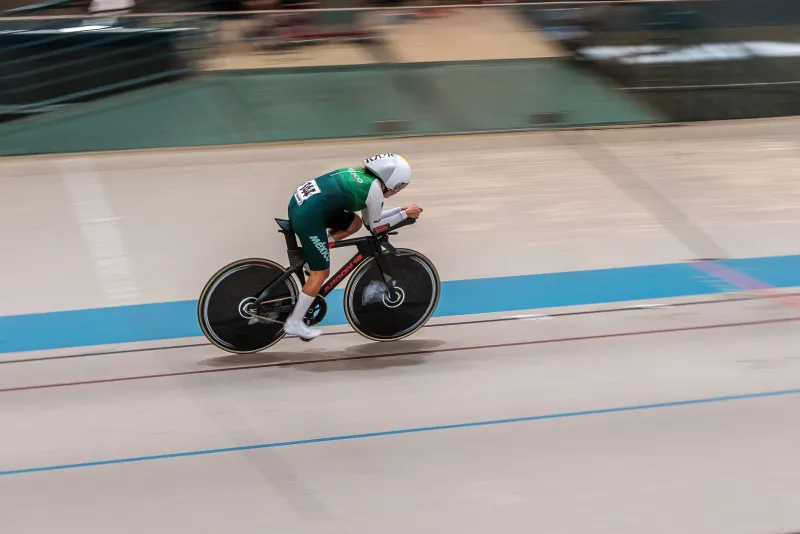
Cycling is one of the most aerodynamically sophisticated sports on the planet. At race speeds, elite cyclists spend somewhere between 70 and 90 percent of their total energy output just overcoming air resistance. The entire sport has been engineered around this reality — the tucked position, the skin suits, the teardrop helmets, the wheel designs. Every variable has been optimized to reduce that frontal area and lower the drag coefficient.
The training that comes with it reflects those demands. Cyclists develop incredible aerobic capacity, highly specific postural endurance to hold a low position for hours, and a cadence-based power output that's fundamentally different from explosive, ground-reaction-force sports.
Now take that training philosophy and hand it to a 100-meter sprinter. The sprinter's aerodynamic reality is almost unrecognizable by comparison. At peak sprint velocity — somewhere around 27 mph for elite athletes — air resistance is a real factor, but it's nowhere near the dominant force. Ground contact mechanics, stride frequency, and explosive hip extension are what actually separate the fast from the faster. The sprinter needs upright posture to maximize power transfer, not a tuck that would compromise stride mechanics entirely.
A cyclist's training block, with its emphasis on sustained output and position-holding endurance, doesn't just fail to help a sprinter — it can actively interfere with the fast-twitch fiber recruitment and neuromuscular patterns that sprint performance depends on.
Swimmers Live in a Different Universe
Move the conversation into the water and the physics shifts again, dramatically. Water is roughly 800 times denser than air. That changes the drag equation in ways that make swimming an almost alien sport from an aerodynamic perspective.
Swimmers aren't really dealing with aerodynamics at all — they're dealing with hydrodynamics, and the drag forces involved are so much larger that even tiny inefficiencies in body position create enormous resistance. A swimmer's drag coefficient and frontal profile matter enormously, but the medium they're moving through means velocity gains are far harder to achieve and maintain.
This is why elite swimmers develop an almost obsessive focus on stroke mechanics and body rotation that has no direct parallel in land-based speed sports. Teaching a competitive swimmer to "train like a sprinter" ignores the fact that their primary resistance problem is viscous drag in a dense fluid, not pressure drag in open air.
Skiing: When Drag Becomes the Whole Game
At the other extreme, downhill skiing might be the sport where aerodynamic drag is most brutally unforgiving. World Cup downhillers regularly exceed 80 mph on technical courses, and at those velocities, the drag force becomes so massive that skiers essentially become human projectiles trying to minimize their own cross-section.
The egg position — that deep, compressed tuck every serious skier learns — exists entirely because of the velocity-squared relationship in the drag equation. Reducing frontal area even slightly at 80 mph produces time savings that would be invisible at 20 mph. The training adaptations required to hold that position under race conditions — the quad endurance, the specific spinal loading, the balance demands — are completely unlike what a cyclist or a sprinter needs.
And yet, generic "speed and power" programs get handed to young ski racers constantly, programs built around vertical jump metrics and sprint times that have limited relevance to the actual aerodynamic problem they'll face on a race course.
Why Generic Speed Training Keeps Failing Amateurs
Here's where this gets personally relevant for the average American weekend warrior or competitive amateur. The fitness industry has built a massive market around the idea of universal athletic development. Ladder drills, resistance parachutes, plyometric boxes — these tools get sold and applied broadly, with the implicit promise that improving general athleticism translates directly to sport-specific speed.
Sometimes it does. Early in an athlete's development, general fitness gains carry over pretty well. But as athletes move up in their competitive levels, the aerodynamic specificity of their sport starts to matter more and more. A masters-level cyclist who spends half their training time doing upright sprint intervals is solving the wrong aerodynamic equation. A competitive masters swimmer who focuses on land-based power without addressing stroke efficiency is fighting the wrong kind of drag entirely.
The drag equation doesn't care about your training philosophy. It cares about the specific combination of velocity, frontal area, and drag coefficient that your sport actually produces.
Training Smarter Starts with Knowing Your Drag Profile
The takeaway here isn't that cross-training is useless or that athletes should never borrow ideas from other sports. It's that smart training starts with understanding the specific aerodynamic problem your sport is asking you to solve.
Ask yourself: At what speeds does my sport operate? What posture does peak performance require? Am I fighting air resistance primarily, water resistance, or is drag a secondary concern compared to ground-force mechanics?
Once you know your drag profile, you can start making smarter decisions about which training methods actually transfer — and which ones are just expensive distractions dressed up in athletic clothing.
Speed is speed, sure. But the physics of how you get there? That's different for every sport on the board.