Geared Up: The Material Science Takeover Changing How American Athletes Compete
There's a conversation happening in locker rooms, design labs, and sports science departments across the country, and it doesn't start with training regimens or playbook strategy. It starts with materials. Specifically, what things are made of — and how that's reshaping the ceiling of athletic performance in ways fans rarely see coming.
We're living through a quiet revolution in sports equipment, and in 2024, the gap between athletes who have access to cutting-edge gear and those who don't is becoming harder to ignore.
Carbon Fiber Finds Its Way Into Everything
If you follow cycling or motorsport, carbon fiber isn't a new concept. But the material's migration into mainstream American sports? That's the story worth telling right now.
Baseball is a prime example. While wooden bats remain mandatory in MLB, the amateur and training equipment world has gone deep on carbon-fiber composite technology. Batting practice tools built with layered carbon weaves offer dramatically different flex profiles than aluminum or ash — allowing coaches to tune the "feel" of contact in ways that were previously impossible. Some training bat manufacturers are even embedding sensors directly into the carbon matrix, capturing data on swing speed, contact angle, and vibration transfer in real time.
"The material itself becomes part of the feedback loop," said one equipment designer at a mid-sized sporting goods company based out of Portland, Oregon. "You're not just swinging a bat anymore. You're swinging an instrument."
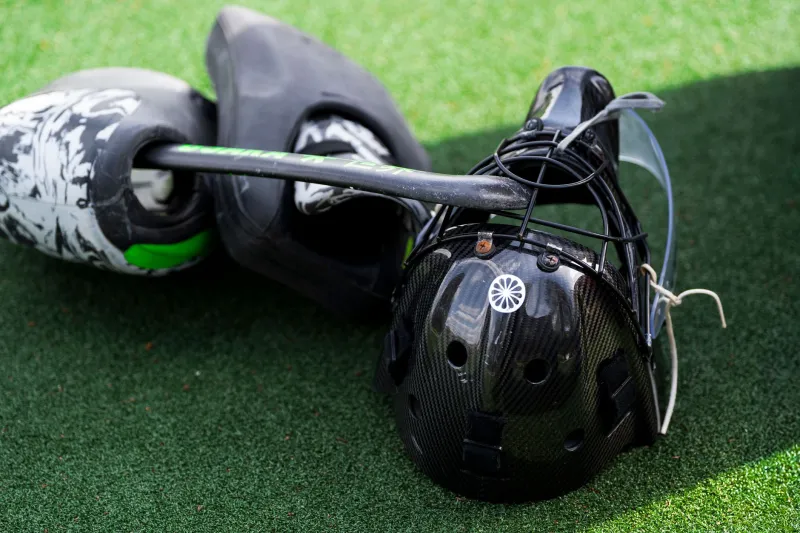
In football, carbon fiber composites are showing up in helmet shells, shoulder pad frames, and even cleat plates. The weight savings are significant — but the bigger story is rigidity. A stiffer frame means energy transfer happens faster, and when you're talking about a lineman firing off the line or a wide receiver planting for a route break, milliseconds matter.
Running Shoes: The Foam and Plate Arms Race
Perhaps no category in American sports has seen a more dramatic equipment transformation than distance running footwear. The introduction of carbon-fiber plate technology embedded in high-stack foam midsoles — pioneered by Nike's Vaporfly line and rapidly matched by Adidas, Brooks, and New Balance — has fundamentally altered what marathon times are possible.
The aerodynamic angle here is subtler but real. Shoe designers are now running full computational fluid dynamics (CFD) simulations on upper materials and outsole geometries, looking at how air flows around the foot during a stride cycle. Mesh patterns, lace configurations, and heel cup shapes are all being evaluated through an aerodynamic lens, not just a cushioning one.
Elite runners have noticed. Several American Olympic hopefuls training in the Pacific Northwest have spoken openly about the sensation of "less resistance" in newer footwear, though they're often careful not to name specific brands due to sponsorship agreements. The data, however, is harder to argue with — world marathon records have fallen repeatedly since carbon-plated footwear became mainstream, and American road racing times at every level are trending downward.
Helmets That Cheat the Wind
Aerodynamic helmet design has long been a staple of cycling and speed skating, but American football is catching up fast. Several NFL teams have worked directly with equipment manufacturers on helmet geometries that reduce drag and improve airflow around the player's head — not just for speed, but for thermal management during high-intensity play.
The engineering challenge in football helmets is uniquely complex. Unlike a cyclist's helmet, which is optimized for a single direction of airflow, a football player changes direction constantly. Designers have responded by developing surface textures and vent placements that perform reasonably well across multiple airflow angles — a compromise that requires serious wind tunnel testing to get right.
One equipment developer who consults with multiple NFL franchises described the process as "designing for chaos." The helmet has to protect, communicate (for players with speaker systems), breathe, and now increasingly, move through air with minimal resistance. That's a lot to ask of a single piece of gear.
What This Means for the Average Fan
Here's the thing about material innovation in sports — it rarely stays at the elite level forever. The carbon-fiber tech in an Olympic cyclist's bike frame eventually finds its way into mid-range consumer bikes. The foam compounds in a $250 racing shoe trickle down into everyday trainers within a few years.
That democratization is part of what makes this moment in sports equipment history genuinely exciting. The aerodynamic and material principles being tested at the highest levels of American sport are laying the groundwork for gear that weekend warriors and high school athletes will eventually use.
Of course, there are equity questions worth asking. If the best gear produces measurably better outcomes, access to that gear becomes a competitive variable in youth and amateur sports — one that often correlates with financial resources. It's a conversation the sports world hasn't fully reckoned with yet.
The Bottom Line
American sports in 2024 are being played with equipment that would have looked like science fiction twenty years ago. Carbon fiber, smart foam, aerodynamic surface engineering, embedded sensors — these aren't gimmicks. They're performance tools that serious athletes and the teams behind them are investing heavily in.
Speed has always met the game at the point of competition. Increasingly, it's also meeting the game in the design lab — long before anyone laces up or steps onto the field.