Jump Smart, Not High: The Aerodynamics of Getting Off the Ground in the NBA
Every spring, the NBA Draft Combine rolls around and the conversation inevitably circles back to one number: the vertical leap. Scouts, analysts, front offices — everybody wants to know how high a prospect can get off the floor. And look, it matters. Nobody's arguing otherwise.
But here's the thing: the combine measures how high you jump. It doesn't measure how well you jump. And in a league where fractions of a second and a few inches of separation decide possessions, that distinction is everything.
The players who actually win the battles above the rim? They're not always the ones who tested highest in Indianapolis. They're the ones who understand — consciously or not — the physics of leaving the ground, traveling through air, and arriving at the ball before anyone else does.
The Air You're Fighting on the Way Up
Here's something most basketball conversations skip entirely: the moment a player leaves the floor, they're no longer just an athlete. They're a projectile. And projectiles have to deal with aerodynamic drag.
Now, basketball isn't cycling or swimming. Players aren't moving fast enough for drag to be the dominant force it is in those sports. But it's not zero, either. A player launching toward the rim at full extension is pushing through air at a meaningful speed, and the shape they make with their body during that movement absolutely affects how efficiently they travel through it.
Think about a player who jumps with their arms flailing wide versus one who drives both arms upward in a tight, controlled motion. The first player creates a broader frontal profile — more surface area pushing against the air. The second player essentially narrows their cross-section, reducing resistance and directing more energy upward rather than outward. Same leg power, different result.
This isn't theoretical. Biomechanical research on jump efficiency consistently shows that arm swing mechanics contribute somewhere between 10 and 20 percent of total jump height. How those arms move — and the drag profile they create — is part of why.
Takeoff Angle: The Variable Nobody Talks About
Vertical leap tests measure pure upward displacement. A player stands, jumps straight up, and the height is recorded. Clean, simple, reproducible.
Game situations are none of those things.
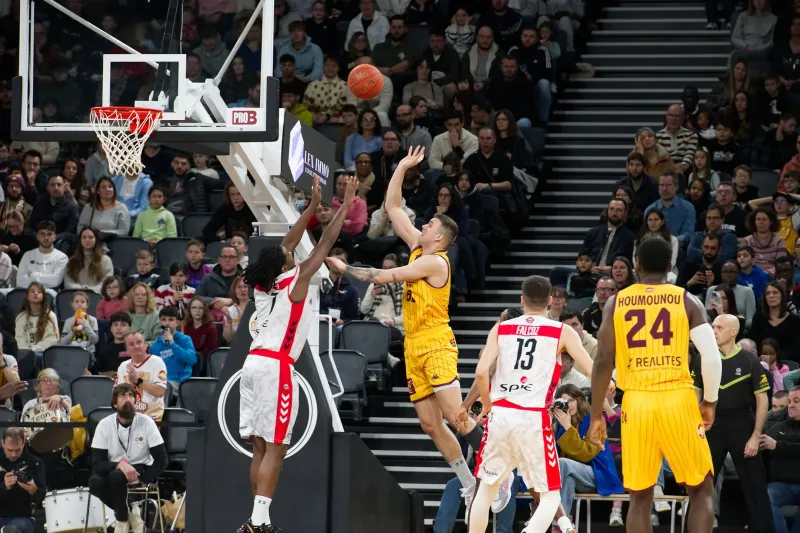
In actual basketball, almost no jump happens in a perfectly vertical line. Players are moving laterally, rotating, fading, or driving forward when they leave the ground. The angle of takeoff changes the entire aerodynamic equation. A player jumping at a slight forward angle while driving the lane has to manage both vertical lift and horizontal momentum simultaneously — and the body position that optimizes one doesn't always serve the other.
Shorter players who consistently beat taller opponents to the ball have often, through years of playing against size disadvantages, developed an intuitive sense of trajectory optimization. They learn to read where the ball is going, position their takeoff so the arc of their jump intersects the ball's path, and minimize wasted motion in the air. Taller players who rely on raw length sometimes never develop that spatial efficiency because they don't have to — until they face someone who has.
Spud Webb winning the 1986 Dunk Contest at 5'7" wasn't just a feel-good story. It was a live demonstration that takeoff mechanics, timing, and body control can compensate for a significant height deficit.
Mid-Air Positioning and Why It's Undercoached
Once a player is airborne, the game isn't over. What they do with their body while they're up there matters enormously.
Elite shot-blockers like Draymond Green — who, at 6'6", regularly contests shots against players three to four inches taller — have talked about reading the shooter's release point and timing their extension to arrive at the peak of their jump at exactly the right moment. That's not just athleticism. That's an understanding of how two bodies move through space at the same time.
From an aerodynamic standpoint, a player who reaches full extension while still rising has used their energy more efficiently than one who peaks early and is already descending when they need to make contact. It's similar to how a receiver in football positions their body to stay in the air long enough to make a contested catch — controlling the descent, not just the ascent.
Body tuck on the way up also plays a role. Players who pull their knees slightly upward during the peak of their jump effectively raise their center of mass relative to the ground, adding functional inches to their reach without generating any additional force. It's a trick that gymnasts and high jumpers have used forever, and the better NBA leapers do it instinctively.
The Numbers That Don't Show Up on the Combine Sheet
Let's talk about a few players who've exposed the limits of raw vertical measurements.
Isaiah Thomas, listed at 5'9" during his time with the Boston Celtics, was a nightmare to defend in the paint not because he was jumping over anyone, but because his takeoff timing and release point were calibrated to make his shot nearly impossible to block despite his height. He understood the geometry of his own jump better than most defenders understood how to counter it.
Al Horford, never known as an explosive leaper, has been one of the better rebounders relative to his position throughout his career. His positioning before the jump — reading angles off the glass, establishing body leverage — means he rarely needs to out-jump anyone. He arrives at the right spot because he calculated the trajectory before anyone else did.
Contrast that with players who test off the charts vertically but struggle to convert that athleticism into consistent above-the-rim production. The jump is only the vehicle. The physics of how you use it determines whether you arrive at the destination.
Training the Smart Jump
So what does this mean practically for players and coaches?
First, vertical leap training shouldn't happen in isolation. Plyometric work that only measures height off the floor is training the combine, not the game. Athletes need to practice jumps from lateral movement, from a step-in drive, from a pivot — all the angles that actually appear during a possession.
Second, arm swing mechanics deserve dedicated attention. If 10 to 20 percent of jump height comes from arm contribution, coaches who ignore that are leaving real inches on the floor. Teaching players to generate upward force with their arms — rather than using them for balance or showmanship — is a concrete, trainable skill.
Third, body tuck and mid-air positioning should be part of any serious jumping curriculum. Filming players during game situations and reviewing how they use their bodies at peak height can reveal inefficiencies that no combine measurement would ever catch.
The Bigger Picture
The NBA's obsession with vertical leap isn't going away, and it shouldn't. Raw athleticism is real and it matters. But the players who build long careers winning battles above the rim — who make All-Defensive teams without being the most explosive jumper on the court — are doing something the combine doesn't measure.
They're jumping smarter. They're managing their body's movement through air with enough precision to consistently arrive at the right place at the right time. And in a sport where every possession counts, that kind of aerodynamic intelligence is worth a whole lot more than another inch on a testing sheet.