Stitched Against the Storm: The Quiet Arms Race to Make Uniforms Disappear
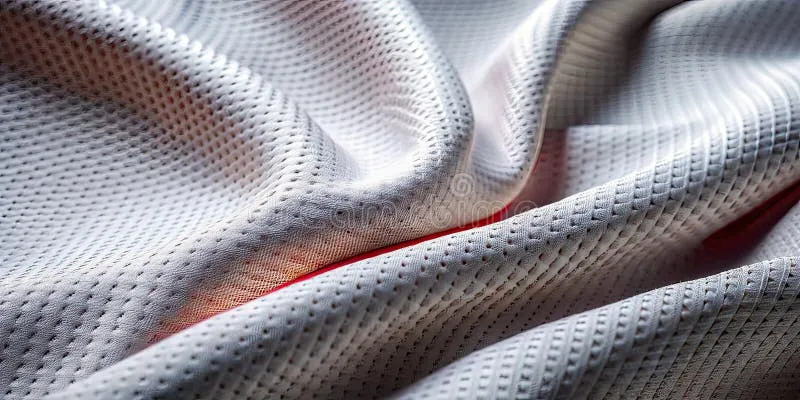
Photo: football jersey fabric close up detail stitching, via thumbs.dreamstime.com
Watch an NFL sideline in August and you'll notice something odd: tiny perforated cutouts laser-burned into the back of jerseys below the shoulder blades. They look like a design flourish. They're not. They're ventilation and drag management, and they're part of a quiet engineering war that most fans never think about.
Here at AeroDyn, we spend a lot of time on the stuff athletes can't control — air density, crosswinds, track surfaces. Uniforms sit in a strange middle ground: fully controllable, frequently botched.
The Jersey Is a Parachute (Unless You Fix It)
A football player moving at top speed isn't cutting a clean hole through the air. He's dragging a fabric shell behind him, and how that shell behaves matters. Loose, heavy material billows. Billowing creates turbulence. Turbulence creates drag — the same drag that separates medalists from also-rans on the track.
The NFL's shoulder cutouts, introduced widely in the 2010s, do two jobs at once: they dump heat and they reduce the sail effect across the largest, fastest-moving surface of the body. Multiply a few grams of resistance over a hundred snaps a game and you get real fatigue savings in the fourth quarter in a September game in Miami.
Sleeveless Economics: When College Hoops Stopped Caring About Sleeves
Basketball's aerodynamic stakes are lower — nobody's running a 40-yard dash — but the sleeveless trend that swept college programs wasn't purely aesthetic. Shooting motion researchers had spent years flagging restricted shoulder extension in sleeved jerseys. Loose sleeves also catch air on jump shots and defensive slides, adding micro-resistance at the exact moment a shooter needs a clean, repeatable motion.
Some programs noticed. Others treated uniforms as a branding exercise first and a performance garment second. Guess which ones have equipment managers who get asked back.
The Programs Treating Fabric Like a Recruiting Pitch
Oregon built a brand on uniform innovation, but the interesting story isn't the 500 combinations — it's that the program partnered with manufacturers early to treat kits as performance equipment. Track programs have gone further. Watch a NCAA championship final and you'll see skinsuits so tight they look painted on, with seam placement mapped to airflow, not tradition.
The recruiting angle is real, if unspoken. A five-star prospect touring a facility notices the recovery pods and the weight room. He also notices that the program's gear fits like it was engineered for him — because it was. When the difference between programs at the top is marginal, marginal stuff compounds.
What Actually Moves the Needle
A few honest takeaways for anyone making uniform decisions, from youth leagues to D-I:
- Fit beats fabric. A loose premium jersey is worse than a tight basic one. Skin-hugging reduces the billow that dominates drag at athlete speeds.
- Seams are spoilers. Flat, minimal seams placed away from high-flow zones reduce both chafing and turbulence.
- Weight matters more in the rain. A cotton-weight jersey soaking through in a downpour can add the equivalent of a weighted vest by the fourth quarter. Synthetic, hydrophobic weaves aren't a luxury.
- Ventilation and drag trade off. More mesh means more cooling but sometimes more turbulence. The best designs pick where to spend each.
The Next Edge Is Stitched, Not Signed
Nobody's landing a recruit because of a jersey alone. But the arms race in college sports has always been about stacking small advantages until they're not small. Programs already fight over nutritionists, sleep scientists, and GPS trackers. The uniform — the one piece of equipment every single athlete touches every single day — is the last frontier where a lot of programs are still making decisions based on how things look in a promotional photo.
The wind doesn't care about your brand. It only cares about your shape. The smartest programs have started designing accordingly, and the gap is only going to widen.