Stop to Go Faster: The Braking Science Hiding Inside Every Great Sprinter's Acceleration
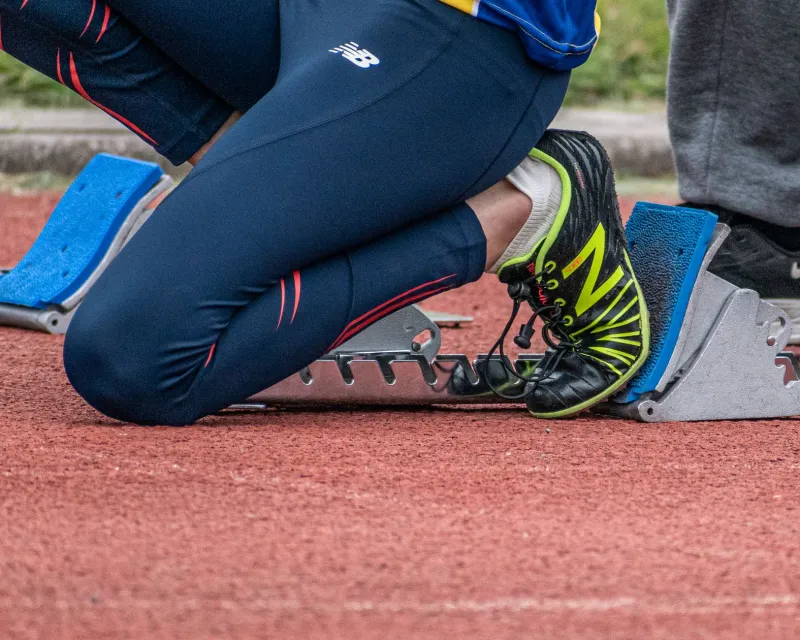
Here's something that doesn't get nearly enough airtime in American track and field circles: the fastest people on the planet are, almost without exception, also exceptional at slowing down. Not because they're cautious athletes. Not because they're playing it safe. But because somewhere in the physics of deceleration lives the secret to their acceleration.
Welcome to what sports scientists are starting to call the deceleration paradox—and once you see it, you can't unsee it.
The Body Doesn't Separate Braking from Driving
Conventional coaching wisdom has long treated acceleration and deceleration as opposite ends of the athletic spectrum. You work on your starts. You work on your top-end speed. Braking? That's mostly an injury-prevention conversation, something you tack onto a training block so your athletes don't blow out a knee on a sharp cut.
But the neuromuscular system doesn't see it that way. When an athlete absorbs force through a rapid deceleration—say, stopping hard after a 40-yard dash or decelerating out of a max-velocity sprint—the muscles responsible for that braking action are working eccentrically. They're lengthening under load. And eccentric muscle contractions, it turns out, are some of the most powerful training stimuli the human body can receive.
The catch? Those same muscle groups—primarily the hamstrings, glutes, and posterior chain—are the exact engines you need firing at maximum output when you explode off the line.
Train the brake, and you're training the gas pedal at the same time.
Ground Contact Time: The Metric That Connects Both Ends
If you want a single number that bridges deceleration ability and acceleration quality, look at ground contact time. Elite sprinters at the collegiate and professional level are spending somewhere in the neighborhood of 80 to 100 milliseconds in contact with the track at top speed. That's less time than it takes to blink.
Here's where it gets interesting: athletes with highly developed braking mechanics tend to have shorter, stiffer ground contacts even during acceleration phases. The reason ties back to what's called leg stiffness—the ability of the limb to behave like a spring rather than a sponge. When you repeatedly train the body to absorb and redirect large forces quickly (which is exactly what aggressive deceleration demands), you're conditioning the tendons, fascia, and neuromuscular pathways to handle rapid force transitions more efficiently.
Shorten your contact time during acceleration and you're applying force to the ground more frequently per second. More force applications, more forward propulsion. The math is pretty straightforward, even if the training path to get there isn't obvious.
Eccentric Strength: The Training Variable Most Programs Undervalue
Walk into almost any high school or Division I strength and conditioning facility in the country and you'll see athletes grinding through concentric-focused lifts. Squats, power cleans, trap bar deadlifts—all valuable, all important. But the eccentric component of training, specifically exercises that stress muscles while they're lengthening under load, often gets treated as an afterthought or a byproduct rather than a deliberate focus.
Nordic hamstring curls, eccentric step-downs, and resisted deceleration drills are still surprisingly rare in mainstream American speed programs despite a growing body of research pointing to their outsized impact on both injury prevention and performance. Athletes who build serious eccentric hamstring strength don't just pull up less often—they also generate more ground reaction force during the initial push-off phase of a sprint.
The feedback loop here is real. Greater eccentric capacity allows for more aggressive deceleration. More aggressive deceleration creates a stronger stretch-shortening cycle. A more powerful stretch-shortening cycle means more elastic energy gets recycled back into propulsion. Round and round it goes.
What Force Plates Are Telling Coaches
Sports performance labs using force plate analysis have started connecting dots that used to go unnoticed on film. When researchers measure the braking impulse—the total force applied in opposition to forward motion during ground contact—they're finding that athletes with higher braking impulse values in controlled deceleration tests often produce higher propulsive impulse values during acceleration testing.
Put plainly: the athletes who can stop the hardest can also go the hardest.
This isn't a coincidence. It reflects the underlying neuromuscular quality of rate of force development, or RFD—how quickly a muscle can ramp up to peak force output. Deceleration training, particularly when it's done at high speeds and involves sudden stops, is one of the most demanding RFD stimuli available. The nervous system adapts by becoming faster and more coordinated at recruiting motor units, and that adaptation doesn't stay confined to the braking context. It bleeds over into every explosive movement the athlete performs.
The NFL Combine Connection
If you follow the NFL Draft process, you've probably noticed that scouts and analytics teams are increasingly obsessed with change-of-direction metrics—not just straight-line speed. The 40-yard dash time matters, but the ability to decelerate, redirect, and re-accelerate is what separates good athletes from elite ones at the next level.
Running backs and receivers who test well in deceleration-heavy drills tend to be the same players who show explosive first-step quickness and sharp route-running at the professional level. That's not a scouting hunch anymore. It's a pattern that biomechanics research is starting to explain from the ground up.
The NFL has inadvertently been selecting for the deceleration paradox for years. They just didn't have the language for it.
Training Smarter, Not Just Harder
So what does this mean practically for athletes and coaches at every level?
First, deceleration work deserves a dedicated spot in your speed development program—not just as injury prevention but as a genuine performance tool. Resisted stopping drills, controlled sprint-to-stop sequences, and eccentric strength blocks should be periodized alongside your acceleration and max velocity work.
Second, don't treat braking mechanics as something you clean up after the fact. Athletes who learn to decelerate with proper posture—shin angle, hip hinge, active foot strike—are also ingraining movement patterns that directly support better acceleration mechanics. The two are more connected than most training plans acknowledge.
Third, if you have access to force plate data or even basic video analysis, start paying attention to how your athletes stop. It'll tell you a lot about how they're going to go.
The Counterintuitive Edge
Speed is the obsession of American sports culture. We love the highlight reel burst, the first step that leaves a defender standing still, the sub-4.3 forty. But the science is making a pretty compelling case that the path to all of that runs straight through the underappreciated art of stopping.
The sprinters who stop better don't just avoid injury. They build a neuromuscular foundation that makes their acceleration more explosive, their ground contacts more efficient, and their overall speed ceiling higher than athletes who've never thought twice about how they brake.
Slow down to speed up. It sounds backwards. But in the physics of elite athletic performance, it makes all the sense in the world.