Breathe Wrong, Lose Ground: The Respiratory Habits Quietly Wrecking Your Performance

You've dialed in your nutrition. You've logged your miles. You've probably even gone down a rabbit hole on compression gear. But here's a question most athletes can't answer confidently: Are you breathing correctly?
Not just deeply — correctly. Because there's a massive difference between the two, and the gap between them is costing athletes at every level more than they realize. Bad breathing mechanics don't just rob your muscles of oxygen. They change your body position, spike your perceived effort, and — yes — even affect how your body moves through the air. At AeroDyn Sports, that last part is kind of our whole thing.
So let's get into it.
The Problem Nobody Sees Coming
When most people think about breathing during exercise, they think about getting winded. That burning sensation in your lungs during the last 400 meters of a race, or the desperate gasping at the top of a steep climb. That's the obvious stuff.
What's less obvious is what your body is actually doing structurally when you breathe inefficiently. Shallow, chest-dominant breathing — the kind most untrained athletes default to under stress — causes your shoulders to creep upward and your chest to puff outward. Your torso tightens. Your neck strains forward. For a runner, cyclist, or swimmer, that shift in posture isn't just uncomfortable. It's aerodynamically costly.
Drag increases with the frontal surface area you're presenting to the air. When your shoulders hike up and your chest flares, you're essentially making yourself bigger — and slower — without realizing it. It's the kind of thing that wouldn't show up on a training log but absolutely shows up on a race clock.
What Elite Athletes Are Actually Doing
Watch elite distance runners or professional cyclists closely and you'll notice something: even at high intensity, their upper bodies stay remarkably still. That's not just good form for its own sake. It's the physical result of diaphragmatic breathing done right.
The diaphragm is a dome-shaped muscle sitting below your lungs. When it contracts properly, your belly expands outward — not your chest. This draws air deeper into the lungs, activating the lower lobes where the majority of your oxygen exchange actually happens. The result is more oxygen per breath, less muscular effort per breath, and a torso that stays compact and controlled.
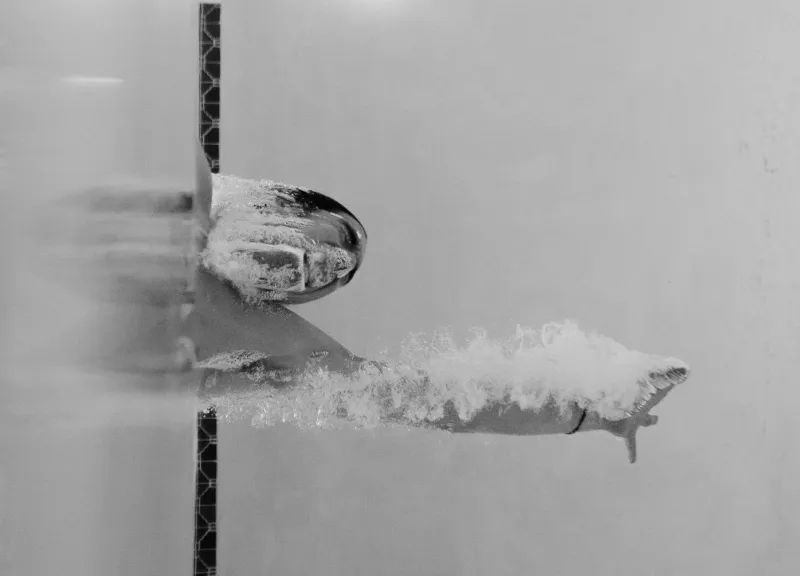
Elite swimmers take this even further. Breath timing in competitive swimming is essentially a form of drag management. Turning your head to breathe creates resistance — so top swimmers train obsessively to minimize rotation, keep the motion quick, and synchronize it with their stroke cycle so it disrupts forward momentum as little as possible. Every unnecessary inch of head rotation is a fraction of a second surrendered to the water.
In sports like rowing and cycling, coaches use breath cadence as a performance cue — syncing exhales with high-effort moments (like the drive phase in rowing) to stabilize the core and maintain power transfer. It's respiratory efficiency as a mechanical advantage.
The Oxygen Efficiency Angle
Beyond posture and drag, there's the straight-up physiological side of this. Your body's ability to use oxygen — not just consume it — is what actually determines how long you can sustain effort.
When you breathe shallowly and rapidly, you create a condition called hyperventilation, which paradoxically can reduce the amount of usable oxygen reaching your muscles. Here's why: carbon dioxide in the blood acts as a trigger for oxygen release from hemoglobin (this is called the Bohr effect). When you breathe out too fast and too often, CO2 levels drop, and your muscles actually have a harder time accessing the oxygen your blood is carrying.
In other words, breathing harder doesn't always mean breathing better. For athletes pushing into high-intensity zones, learning to tolerate a slightly elevated CO2 level — through controlled breathing practice — can meaningfully improve oxygen delivery to working muscles. This is part of why altitude training and breath-restriction protocols have gotten so much attention in endurance sports circles.
Practical Fixes You Can Start Using Now
The good news: breathing is a trainable skill. Here are a few approaches that actually work.
Diaphragmatic breathing drills. Spend 5–10 minutes daily lying on your back with one hand on your chest and one on your belly. Breathe so that only the belly hand moves. It feels weird at first, but it rewires your default pattern faster than you'd think. Once it's automatic at rest, it starts showing up under load.
Cadence breathing during runs. Many coaches recommend a 3:2 inhale-to-exhale ratio at easy paces (three footfalls on the inhale, two on the exhale) and a 2:1 ratio at harder efforts. The rhythm keeps breathing controlled and prevents the erratic gasping that triggers posture breakdown.
Exhale on effort. Whether you're hitting a climb, finishing a lap, or driving through a rep, exhaling at the moment of peak effort stabilizes your core and keeps your chest from flaring. It's a simple cue, but athletes who adopt it consistently report feeling more in control at high intensity.
Nasal breathing at lower intensities. Training yourself to breathe through your nose at easy and moderate efforts builds respiratory muscle strength and improves CO2 tolerance over time. It's uncomfortable at first — your pace will probably drop — but the adaptations are real and they carry over to race conditions.
Post-workout breath work. Recovery breathing — slow inhales for four counts, holds for four, exhales for six to eight — activates the parasympathetic nervous system and speeds the transition out of fight-or-flight mode. Faster recovery between intervals, better sleep, lower resting heart rate. It adds up.
The Bottom Line
Speed is built from a lot of small things done right. Gear matters. Training matters. Positioning matters. But breathing is one of those foundational mechanics that underpins all of it — and it's one of the most overlooked.
If your upper body is tense and elevated mid-race, you're creating drag. If you're hyperventilating under pressure, you're starving your muscles of usable oxygen. And if you've never actually trained your breathing, you're leaving performance on the table that no amount of new gear is going to recover.
The air is already there. You just have to learn how to use it.