The 4.4 Fallacy: How the Combine Learned to Stop Seeing Real Football Players
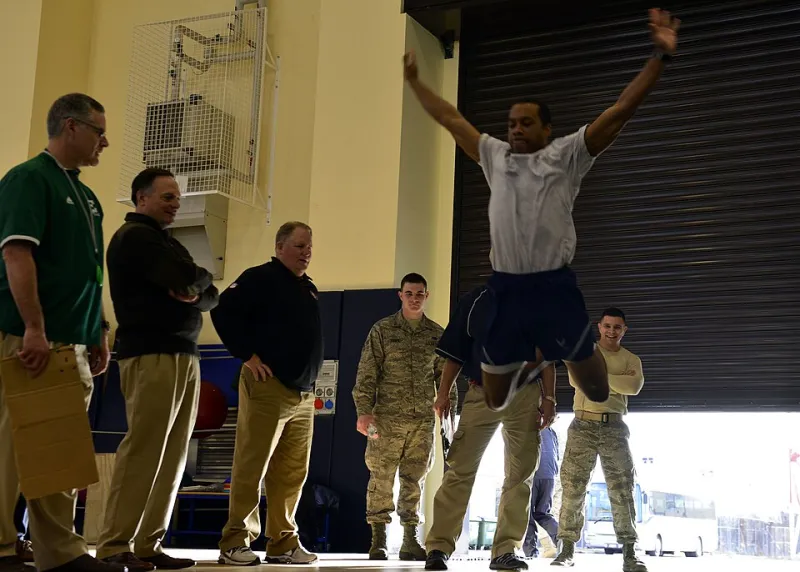
Photo: Airman 1st Class Cary Smith, Public domain, via Wikimedia Commons
Let's get the heresy out of the way up front: the NFL Combine is a fantastic event for measuring how well someone performs at the NFL Combine.
That's not nothing. But somewhere along the way, the league and its media apparatus decided that a 40-yard dash time on an indoor track in Lucas Oil Stadium — no pads, no pursuit angle, no chaos — was a proxy for football ability. It isn't. It's a proxy for one narrow slice of athleticism, and that slice keeps lying to us.
What Straight-Line Speed Actually Measures
The 40 measures acceleration, top-end velocity, and the willingness to run hard in your underwear in front of a stopwatch. What it doesn't measure: the aerodynamic and biomechanical reality of carrying 25 extra pounds of equipment into a headwind, decelerating into a cut, or re-accelerating a second time after your first plan fails.
Football is a sport of repeated stops and starts at odd angles under fatigue. The 40 is one maximal effort with a running start of exactly zero game-like decisions. That's not a flaw in the 40 — it's a flaw in how much weight we give it.
The Busts: When the Stopwatch Wrote Checks the Field Bounced
Combine history is a graveyard of elite testers. The archetype is the workout warrior defensive end — a freak bench-press number, a blazing short shuttle, first-round buzz built entirely on drills. Some become stars. Many become the guys scouts spend a decade quietly avoiding, because testing well in a controlled environment rewards exactly the qualities — straight-line explosiveness, low body fat, great coaching — that don't survive contact with an NFL tackle who's also a freak and also 60 pounds heavier.
The famous cautionary tales vary by era, but the pattern holds: players whose draft stock exploded in Indianapolis and whose tape never matched the numbers. The tape was right. The tape always was.
The Steals: What the Numbers Missed
The inverse list is longer and more fun. Receivers with pedestrian 40s who ran away from everyone on Sundays because their acceleration happened in the first two steps, in a route stem, off a subtle shoulder fake — none of which a straight line captures. Quarterbacks with mediocre arm-strength testing who threw receivers open with timing and trajectory in ways no radar gun measures.
The common thread: the qualities that separate pros from practice-squad players are mostly about how efficiently an athlete moves through space under game conditions — angle of approach, braking mechanics, the ability to change their body's shape in the air. The combine tests almost none of it.
What a Smarter Combine Would Test
If we were building the evaluation from scratch, we'd care about:
- Repeated-effort deceleration — how well an athlete brakes on rep 8 versus rep 1
- Change-of-direction economy — not just cutting speed, but how much energy each cut costs
- Body-shape control mid-air and mid-contact — the ability to present a smaller, sturdier surface to a defender
- Fatigue-adjusted mechanics — does form hold at minute 40 or collapse
Some teams already track versions of this. The smart front offices have quietly de-emphasized the spectacle numbers for years. The public conversation hasn't caught up, because a 4.38 makes better television than a braking-asymmetry score.
Trust the Tape, Then the Timer
This isn't an argument that testing is useless — combine data genuinely helps rule players out and contextualize athleticism. It's an argument about ordering. Watch the player first. Then use the numbers to ask questions, not to answer them.
The next time a draft pick's stock rockets because of a February sprint, remember: the field doesn't have a starting line, nobody's wearing shorts, and the wind doesn't care about your 40.