Finish Line Physics: The Counterintuitive Speed Secret Hidden in Elite Sprinters' Final Strides

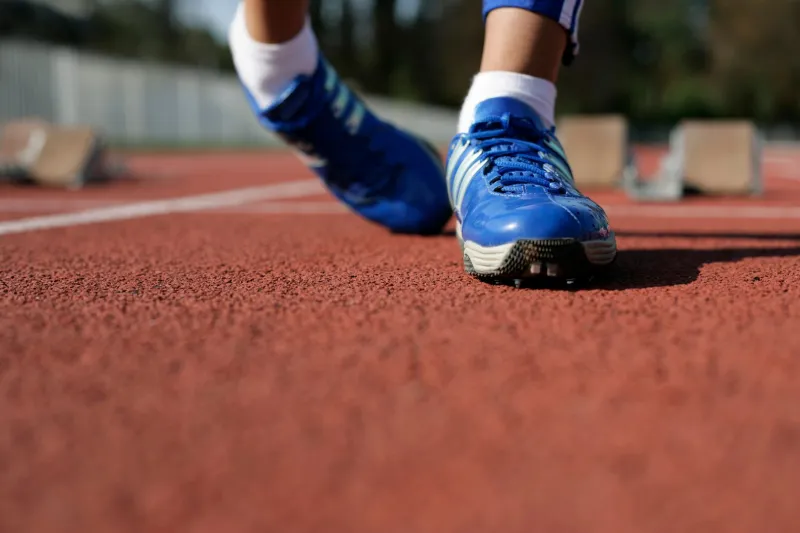
Photo by Photo by Glen Carrie on Unsplash on Unsplash
Here's something that'll mess with your head the next time you watch a 100-meter final: the winner probably slowed down more than you think. Not because they ran out of gas. Not because the moment got too big. But because they knew how to slow down — and that knowledge is what separates the podium from the pack.
Welcome to one of the most misunderstood corners of sprint science. Most fans, coaches, and even a lot of athletes assume the race is won by whoever holds their top speed the longest. And sure, that's part of it. But the real story — the one playing out in the final 20 meters of every elite race — is about something called controlled deceleration. And it's way more interesting than it sounds.
Nobody Actually Holds Top Speed
Let's get one thing straight: no human being maintains peak velocity all the way through a 100-meter race. Physiologically, it's not possible. The body hits maximum speed somewhere between the 60 and 80-meter mark, and from that point on, it's a managed descent. The question isn't if you're going to decelerate — it's how.
Amateur athletes tend to fight this reality. They tense up, over-stride, and essentially try to force their body through a wall it can't break. The result? A choppy, inefficient final stretch where energy hemorrhages through every awkward arm swing and rigid hip. They cross the finish line looking like they're trying to run through wet concrete.
Elite sprinters do the opposite. They accept the deceleration curve and work with it. Their form stays fluid. Their stride frequency adjusts naturally. Their upper body stays relaxed even as their legs are screaming. The result is a velocity decline that's gentler, more aerodynamically stable, and — this is the kicker — faster than the alternative.
The Biomechanics of Letting Go
So what does controlled deceleration actually look like in the body?
At peak speed, a sprinter's ground contact time is brutally short — somewhere in the range of 80 to 100 milliseconds. As fatigue accumulates and velocity begins to drop, that contact time naturally extends. Here's where the fork in the road appears. An athlete who panics and tries to compensate by increasing stride length will shift their foot strike forward, effectively braking themselves with every step. It's the same aerodynamic problem you see in cyclists who sit up at the wrong moment — suddenly you're fighting physics instead of using it.
The athletes who manage this phase well do a few specific things differently. First, they maintain forward lean rather than letting the torso rise. A more vertical upper body increases drag and disrupts the force vector that should be driving them forward. Second, they keep their arm swing tight and rhythmic — loose arms are energy leaks. Third, and most importantly, they let stride frequency carry the load rather than stride length. Shorter, faster steps preserve momentum more efficiently than desperate, reaching strides.
Think of it like a car coming off a highway. You can ride the brakes and feel every bump, or you can ease off the gas and coast. One is a fight. The other is physics working in your favor.
The Amateur Crash-Through Problem
Spend a Saturday morning at any local track meet and you'll see the opposite approach in action. Runners who look smooth through the middle of the race suddenly fall apart in the final stretch. Shoulders rise. Arms flail outward. Hips drop. It's a full-body alarm response — the body sensing fatigue and throwing everything it has at the problem, which unfortunately makes the problem worse.
This "crash-through" pattern isn't just inefficient. It's aerodynamically costly in a way most youth coaches never address. A sprinter whose torso rises in the final 20 meters is presenting significantly more frontal area to oncoming air resistance. At race speeds — even at the high school level where athletes are moving at 18 to 22 miles per hour — that drag increase is measurable. It might only cost a tenth of a second, but in a sport where hundredths decide medals, that's enormous.
More damaging is the psychological loop it creates. Athletes who tense up in the final stretch start expecting to fall apart there. The deceleration becomes self-fulfilling. The body learns the wrong pattern and repeats it faithfully.
Training the Descent
Here's the good news: controlled deceleration is trainable. And it doesn't require expensive equipment or a fancy facility. What it requires is intentional practice of the finish-line phase — something that's surprisingly rare in standard sprint training programs.
One effective approach is "fly-in" or "float" workouts, where athletes accelerate to near-maximum speed over 30 meters and then practice maintaining posture and relaxation through a designated finish zone rather than pushing harder. The goal isn't to run fast. The goal is to run clean while fast is fading.
Another useful drill involves filming athletes from the side during the final 20 meters of race-pace efforts. Most runners are genuinely shocked when they see how dramatically their form degrades. That visual feedback alone can accelerate the correction process significantly.
Coaches at the college level are increasingly building deceleration awareness into their sprint programs, treating the final segment of a race as a distinct technical skill rather than just a stamina problem. It's a shift that's long overdue at the high school and club levels too.
What the Data Actually Shows
Research from biomechanics labs has consistently shown that elite sprinters' velocity curves are smoother than those of slower competitors — not because they decelerate less in absolute terms, but because their deceleration is more gradual and evenly distributed across the final segment of the race. There are no sudden drop-offs. No cliff edges on the speed chart.
When you overlay the velocity curves of, say, a 10.0-second 100-meter runner against a 10.8-second runner, the difference in the final 20 meters is striking. The faster athlete's curve flattens out like a gentle slope. The slower athlete's curve often shows a sharper dip right around the 80-meter mark — the exact moment their form breaks down.
The finish line doesn't reward the fastest person at the starting gun. It rewards the person who manages the physics of the entire 100 meters most intelligently. Sometimes the smartest move is knowing exactly how to lose speed without losing the race.
That's not a paradox. That's just good science.