First Step Forward: The Biomechanics Behind a Truly Explosive Start
Every great play, every stolen base, every blown-by cornerback route — it starts with one thing. The first step. Not the second, not the fifth. The first one. That initial push off the ground is where physics and biology collide in a fraction of a second, and whether that collision goes well for you or not determines everything that follows. Understanding the biomechanics of explosive starts isn't just for track athletes. It's for anyone who wants to move faster when it counts most.
Ground Reaction Force: The Foundation of Everything
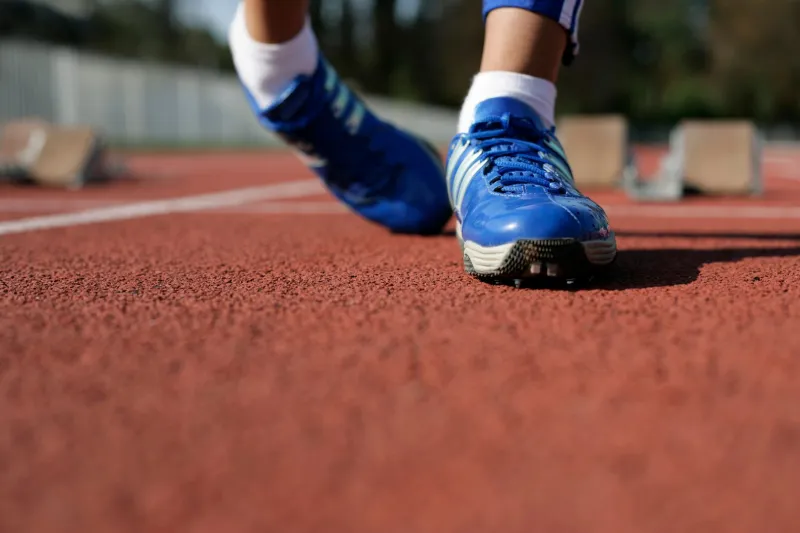
Let's start at the foot. When you push into the ground, the ground pushes back. That's Newton's Third Law, and it's the engine of every explosive start. The force your foot applies into the ground — and the angle at which it applies it — determines how much of that energy translates into forward momentum versus wasted vertical movement.
Elite sprinters apply ground reaction force at a much more horizontal angle than recreational athletes. Instead of pushing down into the ground, they're pushing back against it, driving their center of mass forward. This is why the starting position matters so much. A crouched, forward-leaning stance at the gun isn't just a style choice — it's mechanically optimized to direct force in the right direction.
Research from biomechanics labs consistently shows that the athletes who generate the most horizontal force in their first three steps — not the most total force — are the ones who reach top speed fastest. Power in the wrong direction is just wasted energy.
The Role of the Posterior Chain
Your glutes, hamstrings, and calves are the primary movers in an explosive start. The posterior chain — the muscles running along the back of your body — is your acceleration engine. But here's where a lot of athletes get it wrong: they train their quads for speed because quads feel powerful. They're the muscles you feel burning on a heavy squat. But in the first step off the line, it's the posterior chain doing the heavy lifting.
The glutes drive hip extension, which is the primary movement pattern of acceleration. The hamstrings control both the pull-through of the recovery leg and the deceleration of the swing leg before ground contact. And the calves act as the final force transmitter, converting all that upstream power into ground contact.
Athletes who neglect posterior chain development — and there are a lot of them — often have impressive-looking starts that fall apart mechanically under pressure. They're relying on the wrong muscles for the job.
Hip Position and Trunk Angle: The Invisible Factors
Here's something most athletes never think about: where your hips are when your foot hits the ground matters as much as how hard your foot hits. If your hips are behind your foot at ground contact, you're braking with every step instead of accelerating. You're fighting yourself.
The ideal acceleration posture keeps the hips slightly ahead of the foot strike, allowing the body to function like a falling forward system — gravity becomes an ally rather than an obstacle. This requires a forward trunk lean that feels almost uncomfortably aggressive to athletes who haven't trained it. Your shin angle, your trunk angle, and your hip position all need to sync up to create clean, efficient forward drive.
Coaches at the college and pro level spend enormous amounts of time on this alignment because it's the difference between an athlete who looks fast and an athlete who is fast. Film review and motion capture have made it easier than ever to identify hip and trunk positioning errors — and the findings are consistently humbling for athletes who thought their form was solid.
Arm Action: The Underrated Accelerator
Your arms aren't just along for the ride. In an explosive start, aggressive arm drive directly influences leg speed through a neurological coupling mechanism. When your right arm drives forward, it helps pull your left leg through faster. It's a coordinated whole-body movement, not just a lower-body one.
The arms should move in tight, controlled arcs — elbows bent at roughly 90 degrees, driving back aggressively rather than swinging across the body. Any lateral arm movement is energy leaving the system in the wrong direction. In those first explosive steps, tight and aggressive arm mechanics can meaningfully improve your split times without any change to your lower body training.
This is why you'll see sprinters and skill position players in the NFL working arm drive mechanics as a standalone drill. It's not filler — it's a genuine speed lever.
Muscle Fiber Type and the Starting Gun Reality
Not all athletes are built for the same kind of explosive start. Fast-twitch muscle fibers (Type II) are the primary contributors to explosive power and rapid force production. Athletes with a higher percentage of Type II fibers have a natural head start — literally — in the acceleration phase.
But fiber type isn't destiny. Training can shift the functional characteristics of muscle fibers toward faster twitch behavior, particularly through plyometric training, heavy resistance work, and sprint-specific acceleration drills. The nervous system is also trainable — reaction time and motor unit recruitment speed both improve with consistent, focused practice. You can teach your body to fire faster. It takes time and the right stimulus, but it happens.
Practical Takeaways for the Rest of Us
You don't have to be a track athlete to benefit from acceleration biomechanics. Whether you're a weekend flag football player, a competitive recreational cyclist, or a youth soccer coach, understanding these principles changes how you train and how you coach.
Focus on hip hinge strength and posterior chain development. Practice forward-lean starts from different positions. Film yourself and look honestly at your trunk angle and hip position in those first steps. Add arm drive drills to your warm-up routine. And stop thinking about your first step as just "getting going." It's the most mechanically loaded moment of any athletic movement.
Get the first step right, and everything that follows gets easier. That's not just biomechanics — that's the whole game.